Figma's CEO Says Design Is the New Code. I Agree.
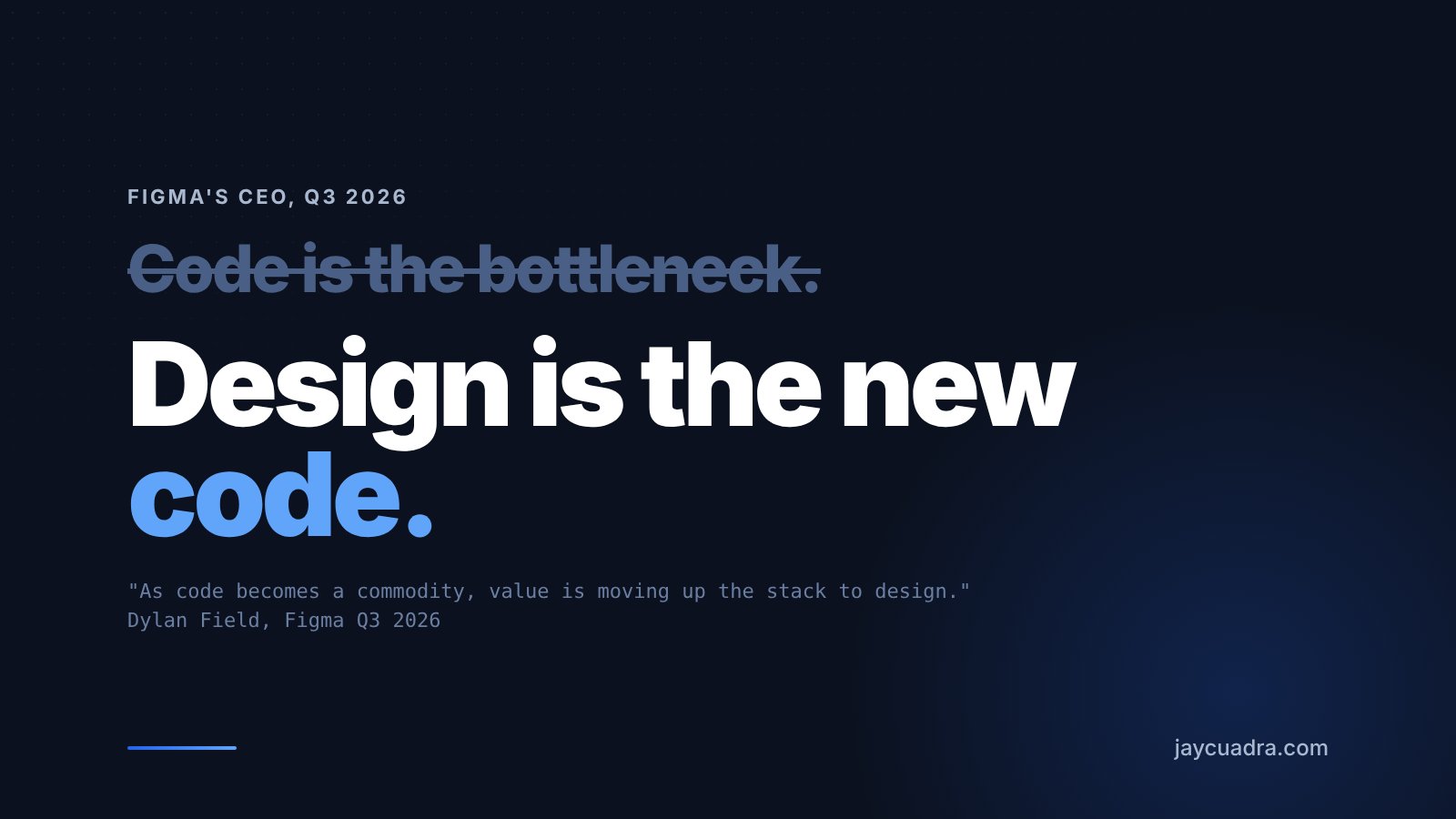
On Figma's Q3 earnings call, Dylan Field said it plainly: design is the new code. In the press release, he put it this way: "As code becomes a commodity, value is moving up the stack to design."
I agree. And I think I see it from a slightly different angle than most designers, because I spent years on the other side of that line.
When code was the bottleneck
I started out around 2010 as a front-end developer, writing HTML, CSS and JavaScript by hand. Back then, the build was the hard part.
A good idea could sit in the backlog for two sprints because nobody had time to code it. Design reviews were partly about taste and partly about cost. If a layout was hard to build, it often didn't survive the meeting, no matter how much better it was for the people using it.
So a lot of design decisions got made by the build. Not on purpose. It was just where the constraint lived.
The bottleneck moved
That's not the case anymore. I can get a working prototype out of Claude Code in an afternoon. Figma is putting working code right on the canvas with Code Layers, so teams can build and compare code-backed prototypes next to the designs.
When building gets that fast, the hard part doesn't go away. It moves.
It moves to deciding what to build in the first place. To figuring out which states actually matter. To knowing what people need to see on the screen, and what they don't. Those questions were always there. They just used to sit behind a two-sprint wait, so nobody had to answer them quickly.
Cheap code makes bad decisions cheap too
Here's what I'd add to what Field said.
When anyone can ship a screen in an hour, you get a lot more screens. Some of them are great. A lot of them are the first idea, built because it was easy, not because it was right.
Cheap code doesn't just make good ideas faster. It makes bad decisions faster too. And bad decisions that ship are expensive, even if the code was free. They confuse users, add one-off patterns to your product, and create work for whoever has to clean them up later.
So the team that wins isn't the one that ships the most screens. It's the one that knows which screen not to ship.
That's design work. It always was. It just used to hide behind the build.
What "design" means when code is cheap
When people hear "design is the new code," some picture designers pushing pixels and nothing else. I don't think that's what it means at all.
From where I sit, the design work that matters most now is:
- Deciding what's worth building. Framing the problem before anyone opens a tool.
- Owning the edges. AI tools nail the happy path fast. Interfaces break in the empty state, the error nobody wrote copy for, and the confirmation someone needs before they hit submit on something that matters. Someone still has to think those through.
- Writing the system down. Token names, component rules, when a pattern is allowed to break. If AI is building from your design system, the system has to be clear enough to follow.
- Watching real people use it. The time I save on the build now goes to sitting with users and seeing where they get stuck.
None of that is new. What's new is that it's the main job instead of the part we squeezed in around production.
The skills I'd sharpen
If code really is becoming the commodity, these are the design skills I'm putting my time into:
- Problem framing. Can you explain what the screen is for, and who it's for, in one sentence?
- Edge-case thinking. Before you approve a flow, list every state it can be in. Empty, loading, error, partial, done.
- Saying no well. Knowing which idea not to build, and being able to explain why in terms the business cares about.
- Systems thinking. Designing the rules, not just the screens, so a person or an agent can extend them.
- Reading the build. You don't need to write production code. But understanding how it fits together helps you judge what AI gives you.
The work moved up the stack
I don't see "design is the new code" as a slogan. I see it as a description of where the constraint went. The build used to be the slow part. Now judgment is.
That's good news for designers who are willing to own it.
So here's my question for you: if code really is the commodity now, which design skills are you working to sharpen?
Written by Jay Cuadra