Five Job Titles, One Job: Where Product Design Goes Next
I've been in product design since before it was called product design.
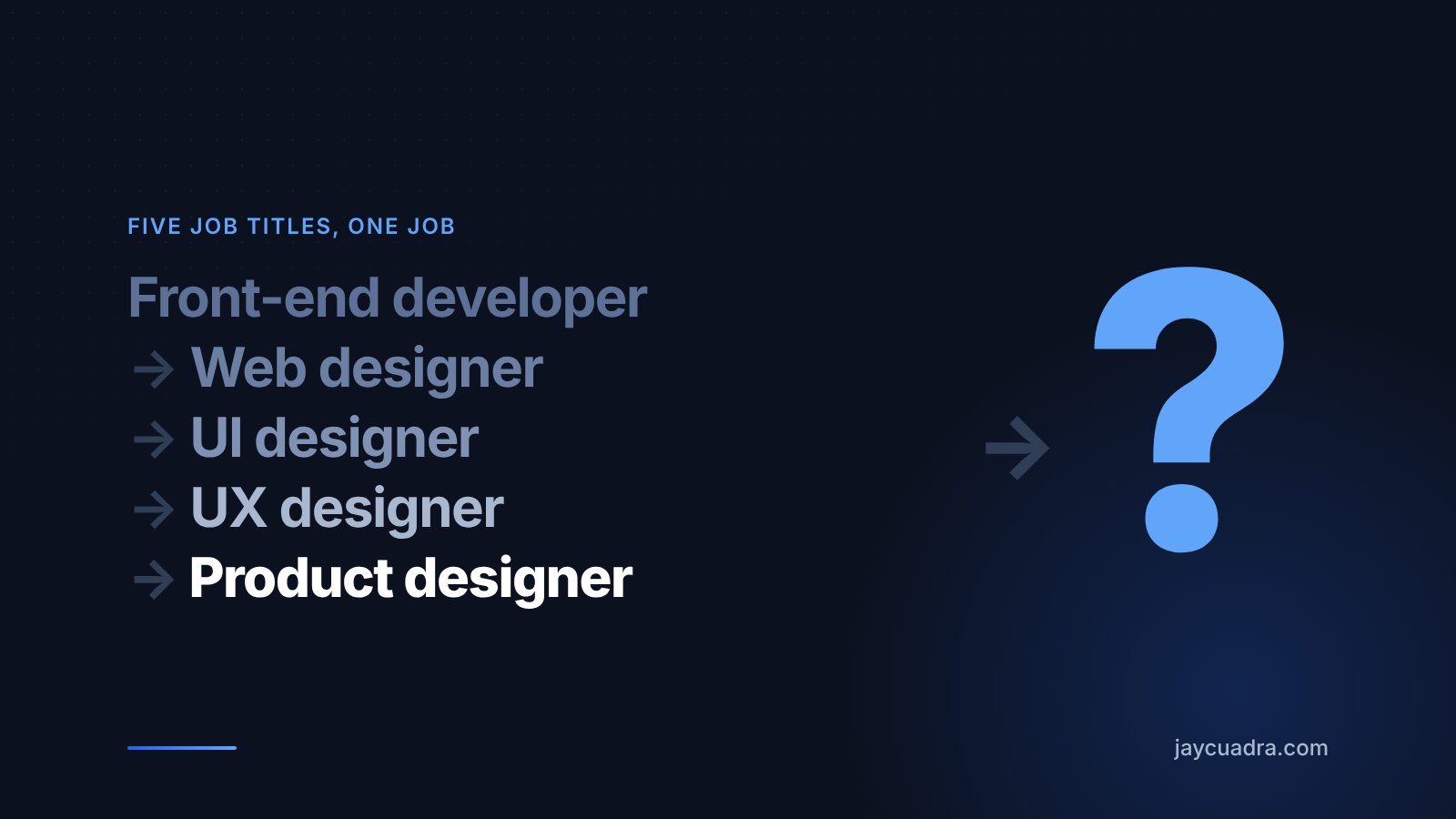
Around 2010 I was a front-end developer, writing HTML, CSS and JavaScript by hand. Since then my title has been web designer, UI designer, UX designer and now product designer. Five titles in about fifteen years.
The funny part is the job underneath barely changed. Figure out what people need. Make it work. Make it hold up when real people use it in ways you didn't plan for.
What changed was the tools. And the tools kept changing the title.
The tools rename the job
When I started, design and code were mostly the same person's problem. If you wanted a button to look a certain way, you wrote the CSS. Then dedicated design tools got good, and design became its own role. Then we went from static mockups to clickable prototypes, and "UX" became the word for caring about the whole flow, not just the screen. Then design systems turned one-off screens into shared components and tokens, and "product designer" became the title for someone who thinks about the whole product.
Every shift followed the same pattern. A new tool made part of the work faster. The part that got faster stopped being the job. The part that was left became the job.
My own shift: from the tool to the people
When I moved from front-end development into UX, I'll be honest about what I actually was: a UI designer. My title said UX. My calendar said Sketch and Adobe XD, all day, every day.
I was good in the tool. I could make a screen look right, fast. What I hardly ever did was the rest of the job. User interviews. Surveys. Digging into the data. Competitive analysis. Testing with real users.
And I paid for it. Without research, every design review turned into a debate about opinions. Someone wanted the button moved. Someone else wanted it back. Another round, another version, another meeting. Endless iterations, and the design got decided by committee instead of by evidence.
That's what changed me. The more research I brought into the room, the more the conversation shifted from "what do we like" to "what did users actually do." And the fewer of those loops we went through.
That was my real evolution as a designer. Not a new tool. Not a new title. I started focusing less on the tools and more on the people.
AI is the next shift, and the biggest
Now the same pattern is happening again, faster than any tool before it. AI can lay out a screen from a prompt. It can generate ten variations before I finish my coffee. It can write a good chunk of the front-end code I used to write by hand.
I'm not worried about that. I'm excited about it. AI is taking over exactly the part of the job I used to hide in: the hours in the tool. That frees up time for the part that actually fixed my work, which is talking to users and understanding the problem.
"Won't AI just replace designers?"
Fair question. I hear it all the time. If AI can make the screens, what's left for us?
Every tool shift I've lived through came with some version of that worry, and each time the job moved instead of disappearing. This one will be no different, but it will move faster.
The designers who feel the squeeze will be the ones doing what I was doing early on: living in the tool and nothing else. If your value is pushing pixels, AI is going to do a lot of that for you. If your value is understanding people and making good decisions, AI makes you faster at the part that matters.
What's left is the job
Here's what AI doesn't do well on its own:
- Decide what's worth building in the first place.
- Notice why a real user keeps getting stuck on the same step.
- Set up the system, the components, tokens and rules, that keeps a hundred screens consistent, whether a person or an agent builds them.
- Explain a decision to a room of stakeholders and get them on board.
That's judgment. Judgment was always the core of the job. It just used to be buried under a lot of production work.
My prediction: the designer's job moves toward two things. Deciding what gets built, and building the systems AI builds from. A design system used to be documentation for people. More and more, it's going to be the instructions an agent reads. If those instructions are vague, the output will be too.
What I'd do now
If you're a designer wondering where this goes:
- Get closer to the decisions. Ask to sit in on planning and roadmap conversations, not just design reviews. Even one meeting a sprint changes how early you hear about problems.
- Do the research you've been skipping. A handful of quick user interviews will settle more debates than another round of internal feedback. If AI is handling your first drafts, spend that time with users.
- Treat your design system like an API. Name tokens and components for what they mean, not what they look like. Write down the rules nobody has written down, like when a component is allowed to break the pattern. An agent can only follow rules that exist.
- Use AI for production work, on purpose. Let it generate the first layout, the variations, the placeholder content. Put the time you save into the problem.
- Keep your craft sharp anyway. You can't judge output you couldn't make yourself.
The title will probably change again. I've watched it change four times already. The judgment won't.
So I'll ask you what I asked on LinkedIn: what do you think this role looks like in 2030?
Written by Jay Cuadra